
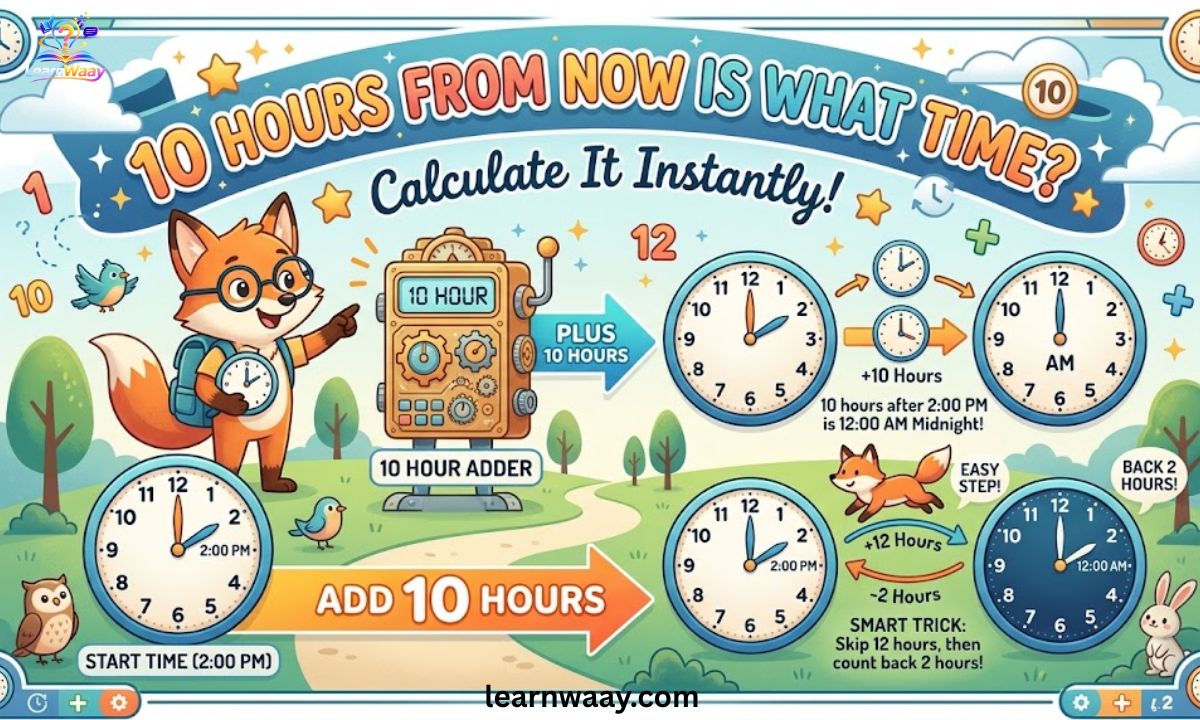

Ever caught yourself glancing at the clock and wondering, “10 hours from now is what time?” Maybe you’re planning a late-night flight, waiting on a work shift to end, or just trying to figure out when you’ll finally get some sleep. Whatever the reason, doing this math in your head can get confusing fast.
The good news is that calculating the time 10 hours from now doesn’t have to involve guesswork or a dozen tabs open on your phone. With a simple method or a quick calculator you can get an instant, accurate answer, even if it crosses midnight or spans a different time zone.
10 Hours From Now is What Time
To find the time 10 hours from now, take the current time and add 10 hours to it. If the result passes 12:00 (noon or midnight), you simply carry over into the next 12-hour block or the next day.
For example, if it’s currently 9:00 AM, adding 10 hours gives you 7:00 PM the same day. If it’s currently 6:00 PM, adding 10 hours pushes you past midnight into 4:00 AM the next day.
The exact answer always depends on your current time, so the safest way to get a precise result is to check the live clock or use a future time calculator, since the answer changes every minute.
What Time Is 10 Hours From Now?
There’s no single fixed answer to “what time is 10 hours from now” because it depends entirely on what time it is right now at your location. The calculation itself, however, never changes:
Current Time + 10 Hours = Future Time
If your current time uses AM/PM format, watch closely for the moment it crosses from AM to PM or vice versa that’s where most people make mistakes.
Understanding 10 Hours as a Time Duration

Ten hours is a significant chunk of the day roughly 42% of a full 24-hour cycle. To put it in perspective:
- A standard work shift plus commute time
- A long-haul international flight
- A full night’s sleep plus a bit extra
- Nearly half of a waking day
Because 10 hours is long enough to cross from one part of the day into a completely different one (morning into evening, or evening into early morning), it’s one of the more common durations people need to calculate — for flights, shift changes, and deadlines.
How to Calculate What Time Is 10 Hours From Now Manually
You don’t need a tool to work this out. Just follow these three steps.
Step One
Note the current time, including whether it’s AM or PM (if using a 12-hour clock) or write it in 24-hour format.
Example: The current time is 5:30 PM (17:30).
Step Two
Add 10 hours to the hour value only, keeping the minutes the same.
Example: 5:30 PM + 10 hours = 15:30 in raw hour terms, but since we’re past 12, we adjust.
In 24-hour format: 17:30 + 10:00 = 27:30
Step Three
If the resulting hour exceeds 24, subtract 24 and move to the next day. If using a 12-hour clock, adjust AM/PM accordingly.
Example: 27:30 − 24:00 = 3:30, so the result is 3:30 AM the next day.
Examples of 10 Hours From Now
| Current Time | Time 10 Hours Later |
| 7:00 AM | 5:00 PM (same day) |
| 12:00 PM (Noon) | 10:00 PM (same day) |
| 3:00 PM | 1:00 AM (next day) |
| 8:45 PM | 6:45 AM (next day) |
| 11:15 PM | 9:15 AM (next day) |
| 12:00 AM (Midnight) | 10:00 AM (same day) |
What Time Was It 10 Hours Ago?
The process works the same way in reverse — instead of adding 10 hours, you subtract 10 hours from the current time.
Current Time − 10 Hours = Past Time
For example, if it’s currently 6:00 AM, then 10 hours ago it was 8:00 PM the previous day. If it’s currently 3:00 PM, 10 hours ago it was 5:00 AM the same day.
This calculation is especially useful when reviewing logs, checking when an event started, or verifying alibi or activity timestamps.
What Time Is 10 Hours From Now Across Midnight?
Crossing midnight is where most manual calculations go wrong. Here’s the rule: if adding 10 hours pushes your total past 12:00 AM, the date rolls over to the next day.
Example:
If it’s 4:00 PM today, adding 10 hours gives 2:00 AM — but that 2:00 AM belongs to tomorrow, not today.
Always double-check the date, not just the time, when your calculation crosses midnight — this matters for scheduling meetings, flights, or reminders that depend on the correct day.
What Time Is 10 Hours From Now in GMT+5?
If you need the time 10 hours from now in a specific time zone like GMT+5, you first calculate 10 hours ahead in your local time, then adjust for the time difference between your zone and GMT+5.
Formula:
Your Local Time + 10 Hours = Your Future Local Time
Your Future Local Time ± Time Zone Difference = GMT+5 Equivalent
For instance, if you’re in GMT+0 and it’s currently 1:00 PM, 10 hours from now it will be 11:00 PM in your zone. To convert that to GMT+5, add 5 hours, giving you 4:00 AM the next day in GMT+5.
Time Zones Change Everything

A 10-hour calculation only tells part of the story if the people or events involved are in different time zones. The actual clock time 10 hours from now can vary drastically depending on location.
| Time Zone | Time 10 Hours From 12:00 PM (Noon) UTC |
| UTC | 10:00 PM |
| EST (UTC−5) | 5:00 PM |
| PST (UTC−8) | 2:00 PM |
| GMT+5 | 3:00 AM (next day) |
| IST (UTC+5:30) | 3:30 AM (next day) |
This is why remote teams, international travelers, and global businesses often rely on world clock tools rather than doing this math by hand.
Using a Future Time Calculator
A future time calculator removes the guesswork entirely. Instead of manually tracking AM/PM shifts, midnight crossovers, or time zone differences, you simply enter:
- The current date and time
- The number of hours to add (in this case, 10)
- Your time zone (optional, for cross-zone results)
The calculator instantly returns the exact future time and date, accounting for all the tricky edge cases automatically. This is especially helpful when the calculation involves multiple time zones or spans across days.
Real Life Uses of Calculating 10 Hours From Now
Knowing how to calculate 10 hours ahead isn’t just a math exercise — it has genuinely practical applications.
Work Shifts
Shift workers, especially those on 10-hour shifts, need to know exactly when their shift ends to plan commutes, meals, and rest.
Flights
Long-haul flights often last close to 10 hours. Passengers and airline staff calculate arrival times by adding flight duration to departure time, then adjusting for time zone changes.
Remote Workers
Employees working with international teams calculate 10-hour offsets to know when colleagues in other time zones will be online or asleep.
Freelancers
Freelancers managing deadlines across time zones use this calculation to confirm submission windows without missing a client’s local deadline.
Students
Students pulling long study sessions or working on assignments track 10-hour blocks to plan breaks, meals, and sleep.
Travel Itineraries
Travelers calculate 10-hour layovers or transit times to plan connecting flights, hotel check-ins, or sightseeing windows.
Medication Schedule
Certain medications are taken every 10 hours. Patients calculate the next dose time to stay consistent and avoid missed or doubled doses.
Online Gaming
Gamers coordinating with international teammates calculate 10-hour time differences to schedule matches, tournaments, or raid times.
How Digital Systems Calculate Future Time
Behind the scenes, digital devices and apps calculate future time using Unix timestamps — a running count of seconds since January 1, 1970. To find a time 10 hours ahead, the system simply adds 36,000 seconds (10 hours × 3,600 seconds) to the current timestamp, then converts that number back into a readable date and time.
This method avoids human errors like miscounting AM/PM or forgetting to roll over the date, which is why calculators and scheduling apps are far more reliable for time-sensitive tasks.
12 Hour Clock vs 24 Hour Clock
Understanding both clock formats helps avoid confusion when calculating future time.
12 Hour Clock
The 12-hour clock splits the day into two 12-hour blocks, labeled AM (midnight to noon) and PM (noon to midnight). It requires tracking the AM/PM label separately from the hour number, which is where most calculation mistakes happen.
24 Hour Clock
The 24-hour clock (also called military time) numbers hours from 00:00 to 23:59 without needing AM/PM labels. Adding hours is more straightforward since there’s no format switch to track you simply add and, if the total exceeds 24, subtract 24 and move to the next day.
| Feature | 12 Hour Clock | 24 Hour Clock |
| Format | 1–12 with AM/PM | 00–23 |
| Midnight | 12:00 AM | 00:00 |
| Noon | 12:00 PM | 12:00 |
| Common Use | Everyday speech, US | Military, travel, Europe, Asia |
| Calculation Ease | Requires AM/PM tracking | Simple addition |
Common Mistakes When Adding 10 Hours
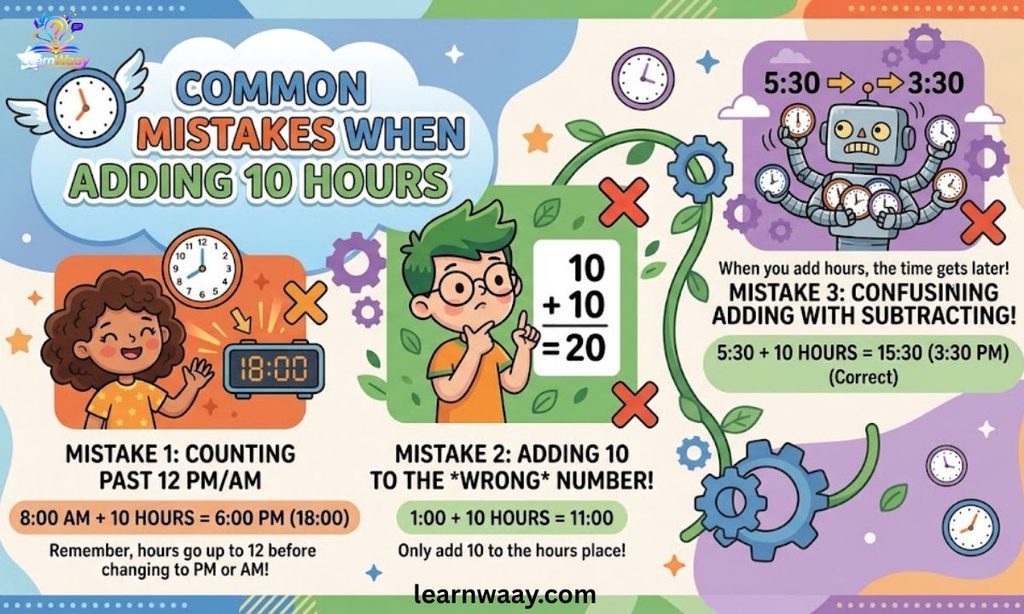
- Forgetting the date change: Adding hours that cross midnight but still labeling it as “today.”
- Mixing up AM and PM: Especially when the addition crosses the 12:00 mark.
- Ignoring time zones: Assuming the same clock time applies globally when coordinating with people elsewhere.
- Miscounting minutes: Focusing only on the hour and accidentally shifting the minutes.
- Using outdated time zone offsets: Some regions observe daylight saving time, which shifts the offset seasonally.
Frequently Asked Questions
What time will it be 10 hours from now?
It depends on your current time simply add 10 hours to it, adjusting the date if the total crosses midnight.
What time was it 10 hours ago from now?
Subtract 10 hours from your current time to find the past time, rolling back a day if it crosses midnight.
How do you calculate hours from a specific time?
Add or subtract the number of hours to the current hour value, then adjust AM/PM or the date as needed.
Is 10 hours from now the next day?
Only if adding 10 hours to your current time pushes the total past 12:00 midnight.
How do I find the time difference between two time zones?
Check each zone’s UTC offset, then add or subtract the difference to convert one zone’s time into the other.
Conclusion
At the end of the day, figuring out “10 hours from now is what time” really comes down to one simple habit: add 10 to your current hour, then adjust for AM/PM or the date if it rolls past midnight. Once that clicks, you’ll never second-guess a shift change, flight arrival, or late-night deadline again. It’s a small skill that saves real confusion.
And if math on the fly isn’t your thing, that’s exactly what future time calculators are for. Punch in your current time, add 10 hours, and let the tool handle the tricky parts like time zones and day changes. Either way, you’ll always know exactly what time it’ll be no guesswork required.

Ethan is an experienced blogger with 4 years of expertise in creating engaging, informative, and reader-focused content. He is currently working with Learnwaay.com, where he shares valuable insights and helps readers discover useful information through well-researched and engaging blog content.
