
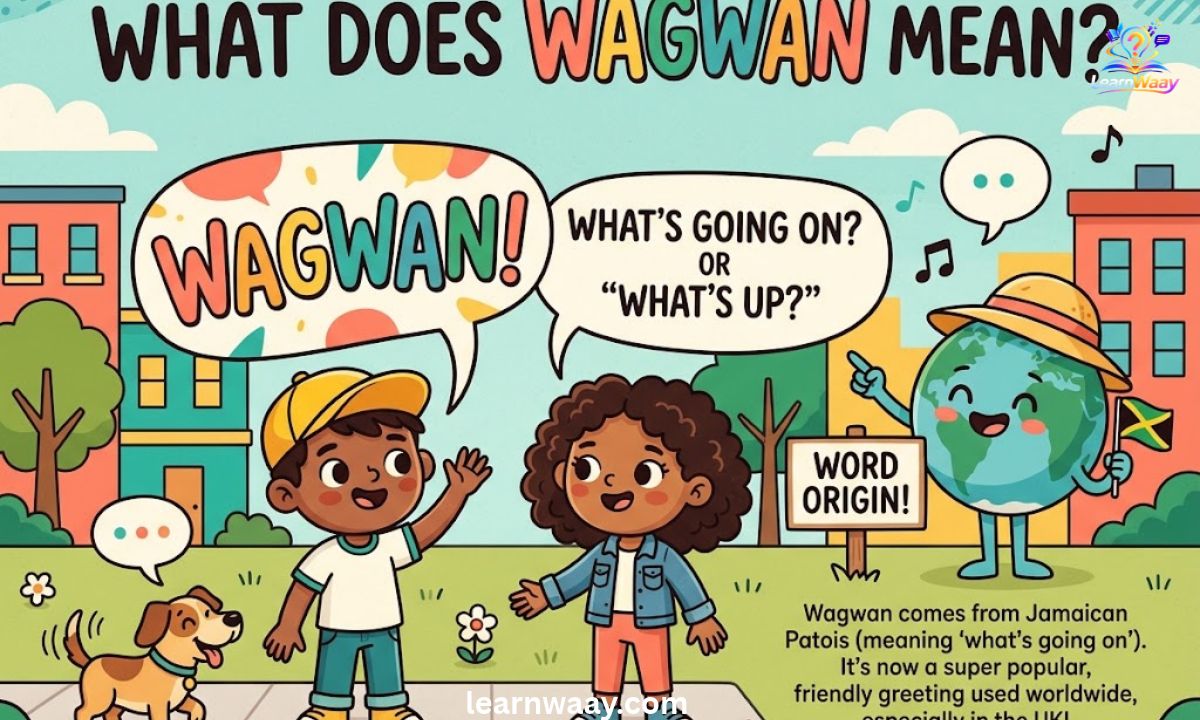

Wondering what does wagwan mean? You’ve probably seen it in a text, heard it in a song or noticed it in a comment section, and wondered if it’s a greeting, a question or something else. Wagwan is a casual greeting from Jamaican Patois that means “What’s going on?” or “What’s up?” It began in Jamaica, spread through Caribbean communities in the UK and Canada, and is now part of British slang, music and online chat.
Because wagwan is spoken slang, its spelling and use can be confusing if you haven’t heard it before. In this guide, you’ll learn what wagwan means, where it comes from, how to pronounce it, how to reply naturally, and when it’s best to avoid it. Whether you’re an English learner or just curious about slang, you’ll find clear examples and simple explanations below.
.What Does Wagwan Mean?
Wagwan is an informal greeting. It’s a spoken-style spelling of “What’s going on?”, “What’s happening?” or “What’s up?”
| Term | Simple meaning | Example |
| Wagwan | What’s going on? / What’s up? | “Wagwan, Sam? Long time.” |
| Wah gwaan | The Jamaican-style spelling of the same greeting | “Wah gwaan, my friend?” |
| Nagwan | Nothing’s going on | “Nagwan, just chilling.” |
It works as a hello and a question at once. It invites an answer, not just a “hi” back.
Origin and History of Wagwan
Wagwan started as a Caribbean, especially Jamaican, greeting. The History of English site notes that the exact date of origin is unknown, but the term appears in print from the 1980s onward. It spread to the UK and Canada as Jamaican and Caribbean communities settled there.
The language behind it is Jamaican Patois (also called Patwa or Jamaican Creole). Patois developed in the 17th century, when enslaved people from West and Central Africa learned and nativised English.
The word breaks down like this:
- wah = what
- gwaan = going on
Put together, the spoken Patois sounds turn into “wah gwaan,” and then the shortened spelling “wagwan.”
Wagwan Meaning British Slang
In the UK, wagwan is strongly linked to Multicultural London English (MLE). Wikipedia describes MLE as drawing on Caribbean English (particularly Jamaican Patois), African English dialects, South Asian languages and Cockney.
Jamaican music helped this along. The popularity of reggae and ska in the UK led to slang rooted in Jamaican patois, laying the foundation for MLE. Dictionary.com says wagwan is used throughout the Jamaican diaspora, especially in South London.
Today it’s common among young people of many backgrounds. Many people first hear it in UK dramas, grime and drill music.Text-slang spellings you may see: “wag1,” “wa gwan” and “wha gwan.”
Wagwan Meaning: A Simple and Complete Guide Jamaica
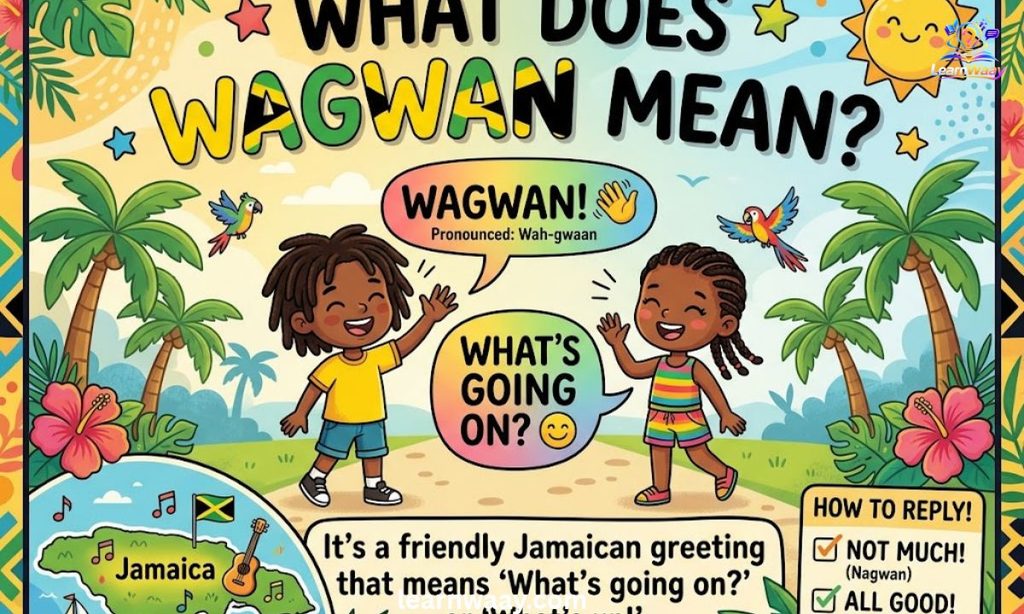
In Jamaica, the form is usually “wah gwaan.” It’s an everyday, relaxed greeting among friends, family and neighbours.
| Situation | Typical use |
| Greeting a friend | “Wah gwaan?” |
| Checking in | “Wah gwaan wid yuh?” (What’s going on with you?) |
| Replying | “Nuttin much.” / “Nagwan.” (Nothing much.) |
Former US President Barack Obama used the phrase in a 2015 speech at the University of the West Indies. According to Dictionary.com, the clip was later sampled by DJs in dancehalls across the island.
Patois is often stigmatised as a low-prestige language, yet it is the mother tongue of most Jamaicans. That is one reason to use its phrases respectfully.
Wagwan Pronunciation
The spelling is easy to misread, so here is a guide.
Wagwan is pronounced: wah-GWAHN
- wah rhymes with “spa”
- gwahn rhymes with “on” in many accents, with a soft “gw” at the start
Stress falls on the second syllable. Say it quickly and casually. Accents vary, so don’t worry about exactness.
Here Are Short Dialogues to Show How Wagwan Is Used Naturally
Dialogue 1: Meeting a friend
Jay: Wagwan, Tia?
Tia: Hey! Not much. Just finished work. You?
Jay: Same. Fancy grabbing food?
Dialogue 2: Group chat
Marcus: Wagwan, everyone? What’s the plan for Saturday?
Lena: Nagwan here. I’m free all day.
Omar: Same. Let’s meet at four.
Dialogue 3: Checking in on someone
Dee: Wagwan? You’ve been quiet all week.
Kofi: Just been busy with exams. Thanks for asking.
Dee: No problem. Message me if you need anything.
Dialogue 4: Social media comment
User A: Just got back from Kingston. Amazing trip!
User B: Wagwan! Send me the photos.
Personality and Usage Context
Wagwan sounds friendly, relaxed and familiar. It signals ease, not formality. People use it with friends, family and peers, seldom with strangers or authority figures.
It can carry a slight “I’m in the know” feel, so tone matters. Said warmly, it’s welcoming. Said as a joke about someone’s accent, it can come across as mocking.
Contexts Where Wagwan Works Well
- Greeting friends in person or by text
- Starting a group chat
- Social media comments and DMs
- Casual conversations in Caribbean or British communities
- Music, comedy and other informal media
Modern and Relatable Examples (Updated for 2026)
| Situation | Example |
| Instagram DM | “Wagwan? Saw your story. Where’s that café?” |
| “Wagwan guys, anyone up for football tonight?” | |
| Comment on a video | “Wagwan! This edit is so good.” |
| Asking about a situation | “Wagwan with the train times today?” |
| Quick reply | “Nagwan, just relaxing.” |
Note the last kind of use: “Wagwan with that?” means “What’s going on with that?” It moves from a greeting to a general question about a situation.
When Not to Use Wagwan
Skip it in:
- Job interviews, cover letters and business emails
- School essays and formal writing
- Messages to people who don’t know the slang
- Any situation where you’d be imitating an accent as a joke
If you’re unsure, use “Hi, how are you?” instead.
Word Form and Grammar Tips
Wagwan isn’t a normal English word, so ordinary grammar rules don’t apply.
- Function: It works as a greeting (an interjection) or as a question.
- No conjugation: Wagwan doesn’t change form for tense or person.
- Punctuation: Usually followed by a question mark, or an exclamation mark for excitement.
- Spelling varies: Wagwan, wah gwaan, wa gwan and wha gwan are all seen. None is the “official” one.
- Related forms: “Nagwan” means “nothing’s going on.”
Wagwan in Music and Culture
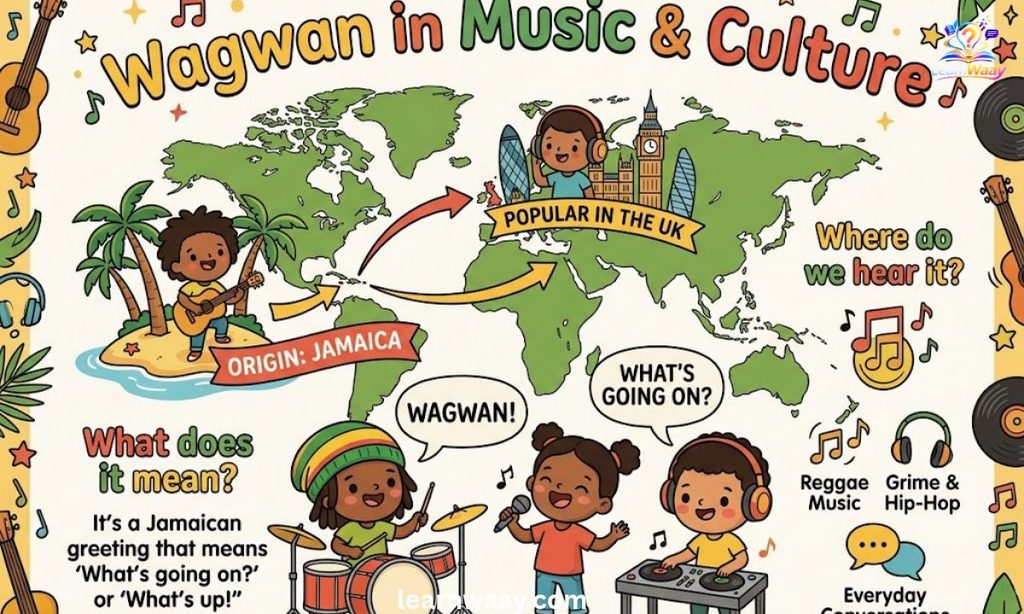
Wagwan grew through reggae, dancehall, grime, drill and hip-hop. Artists use it in lyrics, song titles and intros, which spreads it further. UK street dramas and comedy also popularised it beyond Caribbean communities.
Big Narstie, a British-Jamaican MC quoted by Dictionary.com, described wide use of wagwan as a sign of Jamaican culture’s influence on London. He also noted that he was less pleased when people with little connection to that culture used it.
Here Is How Wagwan Travelled Around the World
| Place | How it appears |
| Jamaica | Original Patois form (“wah gwaan”) |
| UK, especially London | Part of MLE and youth slang |
| Canada, especially Toronto | Jamaican Patois words feature in Toronto slang |
| Online | Global use in captions, DMs and comments |
Migration, music and social media carried it. Now it appears in casual English worldwide.
Why Wagwan Still Matters in 2026
Wagwan is a good example of how language changes. Words from a creole language now appear in everyday conversation far from where they began.
It also shows how slang connects communities. Using it well means knowing where it comes from.
Tips for English Learners
- Learn it as a greeting, not a grammar pattern. Treat it like “hi.”
- Use it with friends first. Don’t use it in formal settings.
- Reply naturally. Try “Not much, you?” or “Nagwan, just chilling.”
- Listen before you copy. Hear how native speakers say it.
- Respect its origin. Avoid exaggerated accents or mocking.
Frequently Asked Questions
What does wagwan mean in simple terms?
It means “What’s going on?” or “What’s up?” and is used as a casual greeting.
Where does wagwan come from originally?
It comes from Jamaican Patois, where “wah gwaan” is a shortened form of “what’s going on.”
Is wagwan British or Jamaican slang?
It’s Jamaican in origin. It became popular in British slang through Caribbean communities and Multicultural London English.
How do you respond to wagwan?
Answer casually: “Not much, you?”, “I’m good, you?” or “Nagwan” (nothing’s going on).
Is it okay for anyone to use wagwan?
Yes, in casual settings. Use it respectfully and don’t mimic the accent as a joke.
Conclusion
So, what does wagwan mean? It’s a friendly Jamaican Patois greeting meaning “What’s going on?” that travelled through migration and music into British slang and online chat. Use it casually with friends, reply with “nagwan” or a quick update, and skip it in formal settings.
Knowing where it comes from makes it easier to use well.The rest of the article stays the same. I can also send the full article with these changes applied, or as a Markdown or Word file.Wagwan is a good example of how language changes. Words from a creole language now appear in everyday conversation far from where they began.

Ethan is an experienced blogger with 4 years of expertise in creating engaging, informative, and reader-focused content. He is currently working with Learnwaay.com, where he shares valuable insights and helps readers discover useful information through well-researched and engaging blog content.
