

Staring at the clock and wondering, “how long till 3:30 PM?” is one of those small daily questions that pops up more often than you’d think. Whether you’re counting down to the end of a shift, waiting for a meeting, or timing a school pickup, guessing the minutes left almost always leads to a wrong answer.
This guide gives you a simple, accurate way to calculate the time remaining until 3:30 PM, no matter what time it is right now.By the end of this article, you’ll know exactly how to work out the countdown yourself, understand why people search for this so often, and discover tools that do the math for you instantly.
Why So Many People Ask: How Long till 3:30
The question “how long till 3:30” shows up constantly in search bars, and it’s rarely about curiosity alone. In most cases, 3:30 PM marks a transition point in someone’s day.
Common reasons people ask this include:
- End-of-shift countdowns: many retail, hospital, and office shifts wrap up around 3:30 PM.
- School dismissal times: a large number of schools release students between 3:00 and 3:30 PM.
- Meeting or call start times: 3:30 PM is a popular slot for afternoon calls.
- Appointment reminders: doctor, dentist, or service appointments often fall in this window.
- Personal deadlines: someone might need to submit work, catch a bus, or leave for an event by 3:30 PM.
Because the answer depends entirely on the current time, there’s no single fixed answer which is exactly why a quick, reliable calculation method (or a countdown tool) is so useful.
How to Calculate How Long Until 3:30 PM
Working out the time left until 3:30 PM only takes basic subtraction once you understand the structure. Here’s the simplest method.
Step-by-Step Manual Calculation
- Note the current time in hours and minutes (use 24-hour format to avoid AM/PM confusion).
- Convert 3:30 PM to 24-hour format, which is 15:30.
- Subtract the current time from 15:30.
- If the current time is earlier in the day, subtract normally.
- If the current hour is greater than 15 (meaning it’s already past 3:30 PM), you’re calculating for the next day instead.
- Adjust minutes first, then hours, just like standard subtraction with borrowing.
Example Calculation
If the current time is 1:15 PM (13:15):
- 15:30 − 13:15
- Hours: 15 − 13 = 2
- Minutes: 30 − 15 = 15
- Result: 2 hours and 15 minutes until 3:30 PM
This method works for any starting time and removes the guesswork entirely.
How Long till 3:30 PM Today Using Common Examples
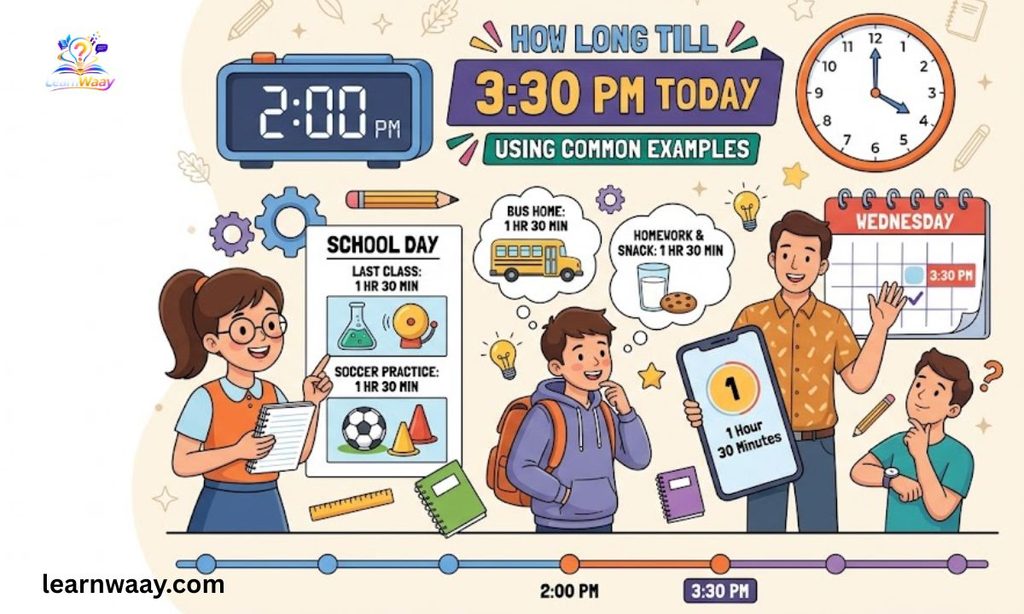
Since the exact countdown depends on the moment you’re checking, here are practical reference points using common current times.
| Current Time | Time Until 3:30 PM |
| 9:00 AM | 6 hours 30 minutes |
| 10:45 AM | 4 hours 45 minutes |
| 12:00 PM (Noon) | 3 hours 30 minutes |
| 1:30 PM | 2 hours |
| 2:50 PM | 40 minutes |
| 3:15 PM | 15 minutes |
| 3:29 PM | 1 minute |
These examples make it easy to estimate your own countdown by finding the closest match to your current time and adjusting slightly.
Using a Countdown Timer Makes Life Easier
Manual math works fine for a one-time check, but if you need to track the countdown continuously say, while working or studying a countdown timer is far more practical.
A countdown timer to 3:30 PM automatically:
- Updates in real time without you doing any calculations
- Removes the risk of subtraction errors
- Adjusts instantly if you check it later
- Can send alerts or notifications as the time approaches
Most smartphones, browsers, and productivity apps offer built-in countdown or alarm features that can be set for a specific clock time rather than just a duration, which is ideal for a fixed target like 3:30 PM.
Why Local Time Matters
One detail people often overlook is that “3:30 PM” isn’t the same moment everywhere. Time zones shift the meaning of that target time significantly.
- If you’re coordinating a call between New York (Eastern Time) and Los Angeles (Pacific Time), 3:30 PM Eastern is only 12:30 PM Pacific.
- International teams need to confirm whose 3:30 PM is being referenced — local, or a specific reference time zone.
- Daylight saving time changes can shift the gap between zones by an hour during part of the year.
Before calculating how long until 3:30 PM, always confirm the time zone that applies to your situation, especially for virtual meetings or remote work schedules.
Understanding Time Formats
Time confusion often comes down to format differences. Knowing both systems helps you avoid mistakes.
| Format | Example for 3:30 PM | Notes |
| 12-hour format | 3:30 PM | Common in the US, UK, and casual daily use |
| 24-hour format | 15:30 | Common in Europe, aviation, military, and scheduling systems |
Quick Conversion Rule
To convert a 12-hour PM time to 24-hour format, add 12 to the hour (except for 12 PM, which stays as 12). So:
- 3:30 PM → 3 + 12 = 15:30
- 12:30 PM → stays as 12:30
Using 24-hour format is often the easiest way to avoid AM/PM mix-ups when calculating time differences.
Everyday Reasons People Wait for 3:30 PM

Beyond the obvious countdown checks, 3:30 PM plays a role in many routines:
- Parents tracking school pickup times
- Employees watching for the end of a shift or workday
- Students waiting for the final class or dismissal bell
- Remote workers scheduling a recurring afternoon meeting
- Delivery drivers working against an afternoon cutoff time
- Fitness routines built around a set afternoon workout slot
Because this time sits in the middle of the afternoon, it naturally becomes a marker for transitions between work, school, and personal time.
How Long Until 3:30 PM Tomorrow?
Sometimes the question isn’t about today at all it’s about tomorrow’s 3:30 PM, especially when planning ahead for an appointment or event.
To calculate this:
- Determine how much time is left until midnight tonight.
- Add the hours from midnight to 3:30 PM tomorrow (which is always 15 hours and 30 minutes from midnight).
Example
If it’s currently 8:00 PM tonight:
- Time until midnight: 4 hours
- Time from midnight to 3:30 PM tomorrow: 15 hours 30 minutes
- Total: 19 hours 30 minutes until 3:30 PM tomorrow
This two-step method keeps the math simple even when crossing into a new day.
Digital Tools That Simplify Time Tracking
While mental math is useful, digital tools remove all room for error. Reliable options include:
- Online countdown calculators where you enter a target time and get an instant result
- Smartphone clock apps with custom alarms set for a specific time
- Calendar app reminders that notify you a set number of minutes before 3:30 PM
- Browser extensions that display a live countdown in your toolbar
- Smart speakers that answer “how long until 3:30 PM” through voice commands
These tools are especially useful for people who check the time repeatedly throughout the day, since they eliminate the need to recalculate manually each time.
Real-Life Situations Where Every Minute Counts
Not every countdown is casual. In several situations, an accurate answer genuinely matters:
- Catching a bus or train with a strict 3:30 PM departure
- Submitting an assignment before a 3:30 PM deadline
- Joining a video call on time to avoid missing key details
- Picking up children before a school’s official closing time
- Taking medication on a fixed schedule tied to a specific time
In these cases, relying on a rough guess can cause real problems, which is why a precise calculation or automated timer is worth the extra few seconds.
Planning Around 3:30 PM
If your day revolves around a 3:30 PM target, a little structure goes a long way.
Tips for planning around a fixed time:
- Set a reminder 15–30 minutes before 3:30 PM to prepare in advance.
- Break remaining tasks into smaller chunks based on the hours left.
- Use a countdown timer instead of repeatedly checking the clock.
- Account for travel time separately if 3:30 PM marks an arrival, not a starting point.
This kind of planning reduces stress and helps you use the remaining time productively instead of watching the clock.
How Countdown Calculators Actually Work
Countdown calculators may feel like magic, but the process behind them is simple arithmetic performed automatically.
Here’s what happens behind the scenes:
- The tool reads your device’s current time.
- It converts both the current time and the target time (3:30 PM) into a common format, usually total minutes from midnight.
- It subtracts the current total from the target total.
- If the result is negative, it adds 24 hours’ worth of minutes, meaning the target time is tomorrow.
- The final number is converted back into hours and minutes for display.
Understanding this logic makes it easier to trust the result and even perform the same calculation manually when a tool isn’t available.
Time Awareness Improves Productivity
Knowing exactly how much time remains until a specific point, like 3:30 PM, does more than satisfy curiosity it directly supports better time management.
Benefits of staying time-aware include:
- Reduced procrastination, since a visible countdown creates gentle urgency
- Better task prioritization, by matching task size to time remaining
- Fewer missed deadlines, especially for recurring afternoon commitments
- Lower stress, since you’re relying on facts instead of guesswork
Small habits, like checking a countdown once instead of glancing at the clock repeatedly, can noticeably improve focus during the workday.
Examples Across Different Dates
The calculation method stays the same regardless of the date, but here are a few scenarios to show how it applies in practice.
| Scenario | Current Time | Target | Time Remaining |
| Monday workday | 11:00 AM | 3:30 PM same day | 4 hours 30 minutes |
| Weekend event | 9:45 PM (previous night) | 3:30 PM next day | 17 hours 45 minutes |
| Early morning | 6:20 AM | 3:30 PM same day | 9 hours 10 minutes |
| Just past target | 4:00 PM | 3:30 PM next day | 23 hours 30 minutes |
These examples confirm that the underlying formula subtracting current time from 15:30, and adding 24 hours when needed holds true across any date.
Making Better Use of the Waiting Time
Once you know exactly how long until 3:30 PM, that information becomes far more useful when paired with a plan for the waiting period.
Ways to use the time productively:
- Tackle a quick task that fits within the remaining minutes.
- Take a short break if the countdown shows plenty of time left.
- Prepare materials or notes needed for whatever happens at 3:30 PM.
- Set a secondary reminder partway through the wait to stay on track.
Instead of treating the countdown as dead time, use it as a natural checkpoint to organize the rest of your day.
Frequently Asked Questions
How do I calculate how long until 3:30 PM?
Convert 3:30 PM to 24-hour format (15:30) and subtract the current time from it; if the result is negative, add 24 hours because the time refers to tomorrow.
What is 3:30 PM in 24-hour time?
3:30 PM is written as 15:30 in 24-hour format.
How long until 3:30 PM if it’s currently noon?
If it’s currently 12:00 PM, there are 3 hours and 30 minutes left until 3:30 PM.
Does time zone affect the countdown to 3:30 PM?
Yes, 3:30 PM in one time zone can correspond to a completely different local time elsewhere, so always confirm which time zone applies.
What if it’s already past 3:30 PM today?
If the current time is later than 3:30 PM, the countdown automatically refers to 3:30 PM tomorrow.
Can I set an alarm for 3:30 PM instead of calculating manually?
Yes, most phones and calendar apps let you set a specific-time alarm or reminder, which removes the need for manual calculation entirely.
Conclusion
At the end of the day, “how long till 3:30 PM” is really just a question about control control over your schedule, your focus, and your next move. Once you know the exact minutes standing between you and that moment, the clock stops being something you fear and becomes something you use. No more guessing, no more anxious glances at your phone every five minutes.
So the next time that question pops into your head, skip the mental math scramble. Do the quick calculation, set a timer, or check a countdown tool then get back to living your day. Because knowing exactly how long till 3:30 PM isn’t just a fun fact, it’s a small habit that keeps your whole afternoon running smoother.

Ethan is an experienced blogger with 4 years of expertise in creating engaging, informative, and reader-focused content. He is currently working with Learnwaay.com, where he shares valuable insights and helps readers discover useful information through well-researched and engaging blog content.
