

Trying to figure out what time was 17 hours ago? Whether you’re tracking down a timestamp, checking when a message was sent, or just satisfying your curiosity, calculating a time 17 hours in the past is simple once you know the method.
This guide walks you through the exact steps, shows real examples, and explains the tricky parts like date rollover, AM/PM shifts, and time zones so you never get a wrong answer again.
What Time Was 17 Hours Ago
To find what time it was 17 hours ago, subtract 17 hours from the current time. If the result goes below 12:00 AM, you roll back to the previous day and add 12 to the leftover hours.
Here’s the quick version:
- Convert to 24-hour time (e.g., 3:00 PM = 15:00)
- Subtract 17 from that number
- If the result is negative, add 24 to it — this also means the date shifts back by one day
- Convert back to 12-hour format if you prefer AM/PM
For example, if it’s currently 3:00 PM, subtracting 17 hours lands you at 10:00 PM the day before.
Understanding the Logic Behind Time Calculation
Clocks reset every 24 hours, which is what makes “hours ago” math a little different from ordinary subtraction. You’re not just subtracting a number you’re working within a loop that resets at midnight.
Think of it like a circular number line with 24 points on it (0 through 23). When you subtract past zero, you wrap around to the other end of the circle rather than going into negative territory. That’s the entire trick behind every hours-ago calculation, including this one.
What Time Was 17 Hours Ago Across Different Examples
Seeing the math applied to a few different starting points makes the pattern click faster than any explanation alone.
| Current Time | Subtract 17 Hours | Result (17 Hours Ago) |
| 3:00 PM | 15:00 − 17:00 = −2:00 → +24:00 | 10:00 PM (previous day) |
| 9:00 AM | 09:00 − 17:00 = −8:00 → +24:00 | 4:00 PM (previous day) |
| 6:00 AM | 06:00 − 17:00 = −11:00 → +24:00 | 1:00 PM (previous day) |
| 11:00 PM | 23:00 − 17:00 = 6:00 | 6:00 AM (same day) |
| Noon (12:00 PM) | 12:00 − 17:00 = −5:00 → +24:00 | 7:00 PM (previous day) |
Notice that the only case where the date doesn’t change is when the current hour is 17 or later in 24-hour format (5:00 PM onward) because subtracting 17 still keeps you within the same day.
Why Date Rollover Matters
Date rollover happens whenever your subtraction pushes the time past midnight into the previous day. Since 17 hours is more than two-thirds of a full day, this happens for the majority of the clock any current time earlier than 5:00 PM will roll the date back by one.
This matters more than it sounds like it should. If you’re checking logs, timestamps, or messages, getting the date wrong by a day can send you looking at the wrong file, the wrong shift, or the wrong record entirely. Always double-check the date, not just the time, when doing this kind of calculation.
How AM and PM Affect the Calculation
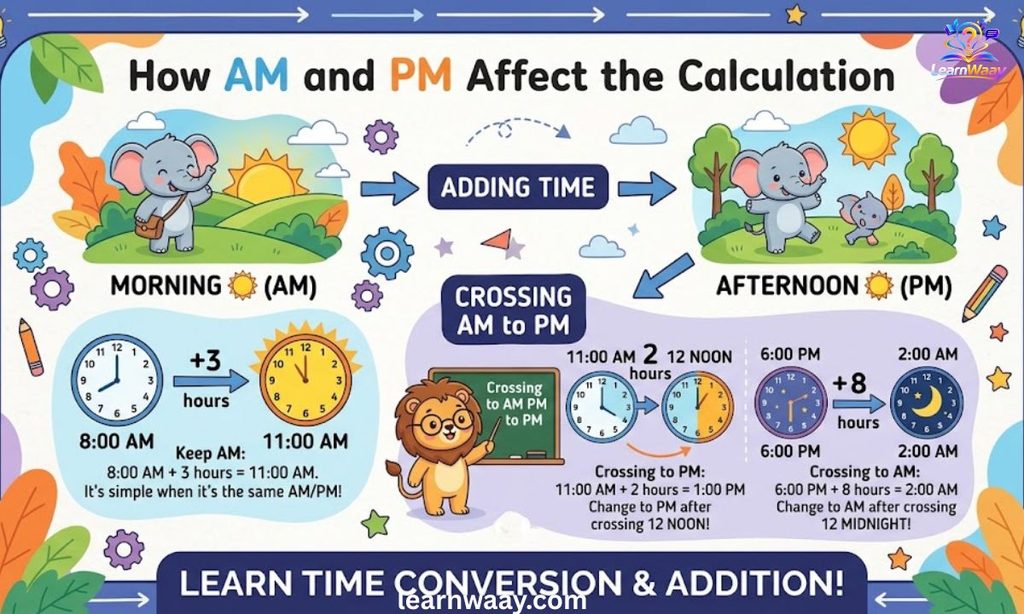
AM and PM aren’t just labels they flip depending on how far the subtraction pushes you across the 12-hour mark. A common mix-up is assuming AM always becomes PM and vice versa; that’s only true about half the time.
- Subtracting 17 hours from a morning time (AM) usually lands you in the afternoon or evening of the previous day.
- Subtracting 17 hours from an afternoon or evening time (PM) usually lands you in the early morning or midday sometimes still PM, depending on exactly how late it currently is.
The safest approach is to always convert to 24-hour time first, do the subtraction, and only convert back to AM/PM at the very end.
Time Zones Can Change the Answer
If you’re calculating “17 hours ago” for an event that happened somewhere else, time zones become the deciding factor. The same moment in real time reads as a completely different clock time depending on where you are.
A few things to keep in mind:
- UTC offset: Always know whether you’re calculating in your local time zone or converting from another one first.
- Daylight Saving Time: If the 17-hour window crosses a DST transition, clocks either skip or repeat an hour, which throws off a plain subtraction by 60 minutes.
- Cross-border coordination: When comparing timestamps between two people in different countries, convert both to a shared reference (like UTC) before subtracting, then convert back.
Using an Hours Ago Calculator
Manual math works fine for one-off checks, but an hours-ago calculator removes the guesswork entirely especially useful when time zones or DST are involved.
A good calculator will:
- Automatically detect your current local time
- Let you enter any number of hours (not just 17)
- Instantly display the resulting date and time
- Adjust for time zone differences if needed
This is the fastest option when accuracy matters more than understanding the mechanics for example, when you’re double-checking a timestamp under time pressure.
What Time Was It 17 Hours Ago in Everyday Life?
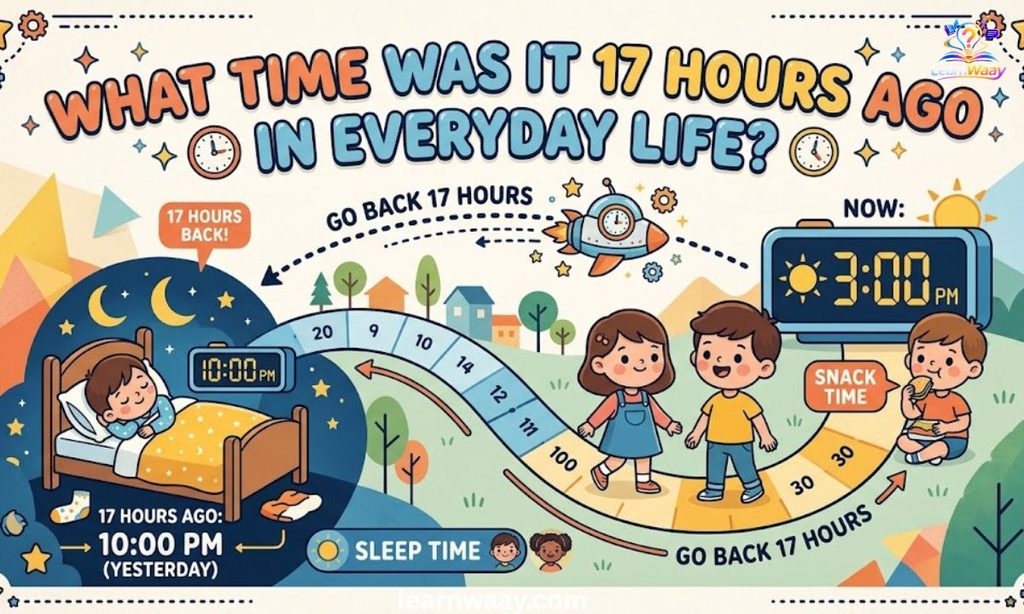
This kind of calculation shows up more often than people expect:
- Checking notifications or messages — figuring out when something was actually sent relative to now
- Reviewing security footage or logs — narrowing down a window of time to investigate
- Coordinating with remote teams — working out what time it was for a colleague when they sent an update
- Tracking flight or travel times — estimating departure versus arrival in different zones
- Health and medication tracking — knowing exactly when a dose or symptom occurred relative to now
The Psychology Behind Looking Back in Time
Interestingly, most people are far better at estimating time forward than backward. Ask someone what time it’ll be in 3 hours, and they’ll answer almost instantly. Ask what time it was 17 hours ago, and there’s usually a pause the brain has to mentally “rewind” rather than simply project forward.
This isn’t a flaw in reasoning; it reflects how human memory and time perception are wired. We naturally organize events in forward-moving sequences, so reversing that flow takes more conscious effort which is exactly why a quick calculation method (or a calculator) is so useful.
Common Mistakes When Calculating 17 Hours Ago
- Forgetting the date change: Focusing only on the clock time and ignoring that the date shifts back a day
- Mixing 12-hour and 24-hour formats mid-calculation: This is the single biggest source of AM/PM errors
- Ignoring Daylight Saving Time: Skipping this check when the calculation spans a DST changeover date
- Assuming AM/PM always flips: As shown earlier, this isn’t always true
- Rounding to the nearest hour: Losing minute-level precision when the original timestamp wasn’t on the hour
Manual Time Subtraction Method
If you want to do this without any tool, here’s the reliable step-by-step approach:
- Write down the current time in 24-hour format
- Subtract 17 from the hour value
- If the result is negative, add 24 to it and mark the date as “previous day”
- Convert the final hour back into 12-hour AM/PM format if needed
- Double-check by counting backward in smaller chunks (e.g., subtract 12 first, then the remaining 5) as a sanity check
That last step is worth doing even when you’re confident breaking 17 into 12 + 5, or 10 + 7, gives you a second path to the same answer and catches arithmetic slips.
Why Accurate Time Computation Matters
Small time errors compound into bigger problems. A one-hour miscalculation might not matter for a casual question, but it can seriously affect:
- Legal and forensic timelines, where minutes can determine sequence of events
- Financial transactions, where timestamps affect processing and record order
- Scientific data logging, where precision is often non-negotiable
- Scheduling across time zones, where a wrong hour means a missed meeting entirely
Getting comfortable with the method rather than just memorizing one answer means you can apply it accurately to any number of hours, not just 17.
Human Perception of Time Is Surprisingly Weird
Beyond the psychology of forward versus backward thinking, humans are also notoriously bad at estimating elapsed time in the moment. Seventeen hours can feel like nothing when you’re asleep for most of it, or like an eternity when you’re waiting for something.
This subjective distortion is well documented in time-perception research and is part of why external tools clocks, calendars, and calculators exist in the first place: our internal sense of time simply isn’t reliable enough on its own.
Practical Tips for Calculating Previous Time Quickly
- Break 17 into easier chunks subtracting 12 then 5, or 10 then 7, is often faster mentally than subtracting all at once
- Anchor to midnight or noon these are easy reference points to subtract toward and from
- Always confirm the date, not just the time, especially for anything past 5:00 PM
- Use 24-hour time for any calculation involving more than a few hours it avoids AM/PM confusion entirely
- Keep a calculator bookmarked for moments when accuracy matters more than speed
Frequently Asked Questions
What time was 17 hours ago if it’s currently 3 PM?
If it’s currently 3:00 PM, 17 hours ago was 10:00 PM the previous day.
Does the date always change when subtracting 17 hours?
Not always only when the current time is earlier than 5:00 PM (17:00). After that, the result stays on the same day.
How do I calculate 17 hours ago across time zones?
Convert both the starting time and result to a common reference like UTC, subtract 17 hours there, then convert back to the target time zone.
Is there a difference between “17 hours ago” and “17 hours before now”?
No, both phrases mean the same thing a point in time exactly 17 hours earlier than the current moment.
What’s the easiest way to avoid mistakes in this calculation?
Convert to 24-hour format before subtracting, and only switch back to AM/PM after you’ve confirmed the date.
Conclusion
Figuring out what time was 17 hours ago doesn’t have to feel like a math puzzle. Once you know the simple trick subtract 17 from the current 24-hour time and roll back a day if needed you can solve it in seconds, no calculator required. It’s a small skill, but one that instantly makes tracking timestamps, messages, and schedules far less confusing.
So next time someone asks “what time was 17 hours ago?”, you won’t just have an answer you’ll know exactly how you got there. Whether you’re double-checking a notification, coordinating across time zones, or just satisfying a curious moment, this method has you covered every time. Bookmark it, remember it, and you’ll never lose track of time again.

Ethan is an experienced blogger with 4 years of expertise in creating engaging, informative, and reader-focused content. He is currently working with Learnwaay.com, where he shares valuable insights and helps readers discover useful information through well-researched and engaging blog content.
