


To find what time was it 15 hours ago, subtract 15 hours from the current time. A quick shortcut is to subtract 12 hours first, which flips AM to PM or PM to AM and moves back one day, then subtract 3 more hours to get the exact time. For example, if it is 9:00 AM now, it was 6:00 PM yesterday, 15 hours ago.
This guide explains how to calculate what time was it 15 hours ago using a simple method, a ready-to-use reference table, and time zone examples for the UK, Central Time, EST, and PST. You will also learn about common calculation mistakes and how to avoid them for accurate results.
What Time Was It 15 Hours Ago? The Exact Answer
The answer depends on your current local time, so no single clock time fits everyone. The rule never changes:
Current time − 15 hours = the time 15 hours ago
Quick examples:
- Now 3:00 PM → 15 hours ago was 12:00 AM (midnight) today.
- Now 10:30 AM → 15 hours ago was 7:30 PM yesterday.
- Now 11:00 PM → 15 hours ago was 8:00 AM today.
About the “live countdown”: a static article cannot read your clock. A live hours ago calculator or your phone’s world clock updates automatically. Use the steps below to check any result by hand.
Understanding the Time Calculation Process
Time works in a 24-hour cycle, so subtracting hours is simple once you know where midnight sits.
- Write down the current time.
- Subtract 15 hours.
- If the result goes below 12:00 AM, add 24 hours and move the date back one day.
- Check whether AM or PM changed.
The 12 + 3 shortcut
Fifteen hours is 12 hours plus 3 hours. Subtracting 12 hours only flips AM/PM, so you just handle the extra 3 hours afterward.
Example: it is 2:00 PM. Flip to 2:00 AM, then subtract 3 hours to get 11:00 PM the previous day. So 15 hours ago was 11:00 PM yesterday.
Why People Ask “What Time Was It 15 Hours Ago?”

The question comes up in everyday situations:
- Tracking sleep or fasting windows
- Checking when a message, email, or order was sent
- Working out medication or feeding timing (confirm with a professional for medical schedules)
- Calculating shift lengths and overtime
- Reviewing server logs, deadlines, or flight times
- Settling “when did that happen?” questions
What Time Was It 15 Hours Ago Across Different Parts of the Day
Use this table as a reference. Times assume the same time zone throughout.
| Current time | 15 hours ago | Day |
| 12:00 AM (midnight) | 9:00 AM | Previous day |
| 3:00 AM | 12:00 PM (noon) | Previous day |
| 6:00 AM | 3:00 PM | Previous day |
| 9:00 AM | 6:00 PM | Previous day |
| 12:00 PM (noon) | 9:00 PM | Previous day |
| 3:00 PM | 12:00 AM (midnight) | Same day |
| 6:00 PM | 3:00 AM | Same day |
| 9:00 PM | 6:00 AM | Same day |
| 11:59 PM | 8:59 AM | Same day |
Pattern: any current time from 3:00 PM onward lands on the same calendar day. Any time before 3:00 PM lands on the previous day.
What Happens When You Cross Midnight?
Crossing midnight is where most errors happen. When subtracting takes you past 12:00 AM, the date moves back by one day.
Example: it is 8:00 AM on Thursday.
- 8 hours ago = 12:00 AM Thursday (midnight).
- 7 hours remain, so 5:00 PM on Wednesday.
Answer: 15 hours ago was 5:00 PM on Wednesday.
If the subtraction also crosses the first day of a month or year, the month or year changes too. For example, 15 hours before 6:00 AM on January 1 is 3:00 PM on December 31 of the previous year.
Using an Hours Ago Calculator
An hours ago calculator takes a start time and a number of hours, then returns the earlier time and date. Most tools work like this:
- Enter the number of hours (15).
- Use the current time or choose a custom one.
- Pick your time zone.
- Read the result, including the date.
Why an Hours Ago Calculator Is Helpful
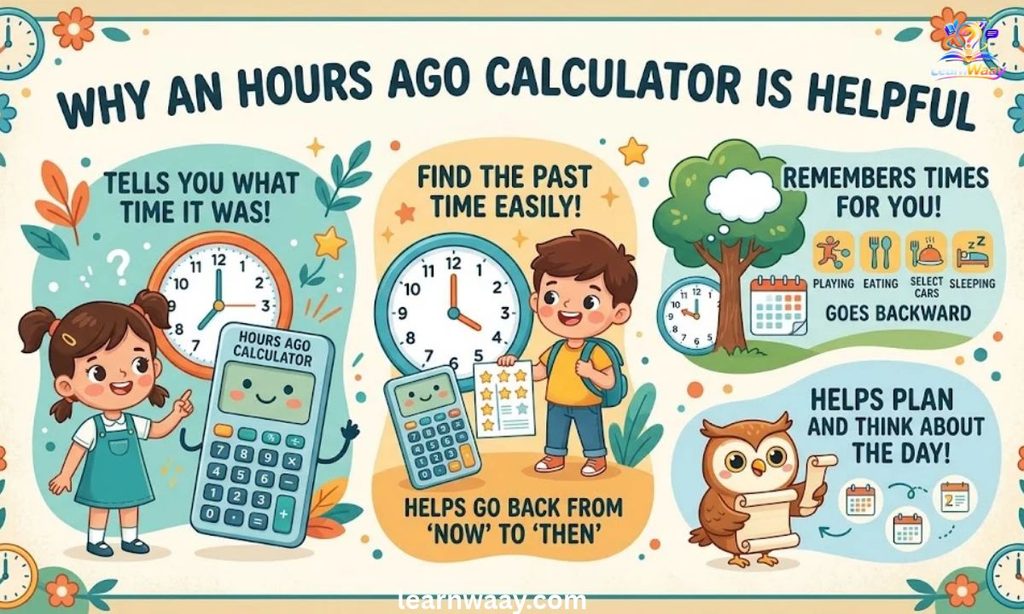
- It handles midnight and date changes automatically.
- It accounts for daylight saving time when a time zone is selected.
- It removes 12-hour versus 24-hour clock confusion.
- It is faster for repeated lookups, such as shift or log reviews.
The Role of Time Difference in Daily Life
Time difference is the gap between two clock readings, whether on the same clock or in different places. It matters for scheduling calls across countries, planning travel, reading timestamps, and coordinating remote teams. Subtracting hours from a single clock is the simplest case. Time zones add a second layer.
What Time Was It 15 Hours Ago in Different Time Zones?
Each time zone is offset from UTC (Coordinated Universal Time). The subtraction of 15 hours works the same everywhere. What changes is the local clock reading.
| Time zone | UTC offset (standard) | Example: now 12:00 PM local | 15 hours ago, local |
| UTC / GMT | UTC+0 | 12:00 PM | 9:00 PM previous day |
| EST | UTC−5 | 12:00 PM | 9:00 PM previous day |
| CST | UTC−6 | 12:00 PM | 9:00 PM previous day |
| PST | UTC−8 | 12:00 PM | 9:00 PM previous day |
The local result is the same because each row starts from that zone’s own local time. The difference appears when you compare zones at the same moment. At 12:00 PM UTC, it is 7:00 AM in EST. Fifteen hours earlier, it was 9:00 PM UTC and 4:00 PM EST the previous day.
Manual Time Subtraction Made Easy
Three methods work without any tool:
- Shortcut: subtract 12 (flip AM/PM), then subtract 3.
- 24-hour clock: convert to 24-hour time, subtract 15, and add 24 if the result is negative. Example: 14:00 − 15 = −1, so −1 + 24 = 23:00 the previous day.
- Midnight anchor: subtract the hours since midnight first, then subtract the rest from 24:00.
Time Conversion Beyond Hours
15 hours equals:
| Unit | Value |
| Minutes | 900 |
| Seconds | 54,000 |
| Days | 0.625 (5/8 of a day) |
To subtract 15 hours and 30 minutes, subtract the 15 hours first, then take off 30 minutes. Example: 4:15 PM − 15 hours = 1:15 AM; minus 30 minutes = 12:45 AM.
What Time Was It 15 Hours Ago Versus What Time Is 15 Hours From Now?
| Question | Operation | Example from 9:00 AM |
| 15 hours ago | Subtract 15 hours | 6:00 PM yesterday |
| 15 hours from now | Add 15 hours | 12:00 AM (midnight) tonight |
Both calculations land exactly 15 hours away from now, one in the past and one in the future. Together they span a 30-hour window.
Using a Hours From Now Calculator
An hours from now calculator works like the hours ago version but adds time. Enter 15 hours, and it shows the future time and date. It is useful for planning deadlines, travel arrivals, long shifts, and timers.
Online Tools That Simplify Time Arithmetic
- Date and time calculators: add or subtract hours, minutes, and days.
- World clock tools: compare several cities at once.
- Time zone converters: translate one local time into another.
- Built-in phone clocks and calendar apps: add multiple time zones and set reminders.
Pick tools that show the date, not just the time, so midnight crossings are obvious.
Common Mistakes When Calculating Previous Time

- Forgetting the date change. Subtracting past midnight means “yesterday.”
- Mixing AM and PM. 12:00 AM is midnight and 12:00 PM is noon.
- Ignoring daylight saving time. If a clock change happened in the 15-hour window, the real elapsed time may differ by an hour.
- Using the wrong time zone. Check which zone your timestamp uses.
- Subtracting 15 from the minutes. Hours and minutes are separate parts of the time.
What Time Was It 15 Hours Ago Tonight
“Tonight” usually means a time between about 6:00 PM and midnight. Fifteen hours earlier falls in the morning.
| Tonight’s time | 15 hours ago |
| 7:00 PM | 4:00 AM today |
| 9:00 PM | 6:00 AM today |
| 11:00 PM | 8:00 AM today |
When Was 15 Hours From Now
This phrasing usually means “what clock time will it be 15 hours from now?” Add 15 hours to the current time.
Example: now is 7:00 PM. Adding 12 hours gives 7:00 AM, and 3 more gives 10:00 AM tomorrow. So 15 hours from now is 10:00 AM tomorrow.
What Time Was It 15 Hours Ago UK
The UK uses GMT (UTC+0) in winter and British Summer Time, BST (UTC+1), in summer. The clocks change on the last Sunday of March and October. The subtraction is the same, but check which offset applies on the date you need.
Example: it is 2:00 PM in London. Fifteen hours ago was 11:00 PM the previous evening, local time.
What Time Was It 15 Hours Ago Central Time
Central Time is CST (UTC−6) in winter and CDT (UTC−5) during daylight saving time. Example: it is 8:00 PM Central. Fifteen hours ago was 5:00 AM the same day.
What Time Was It 15 Hours Ago EST
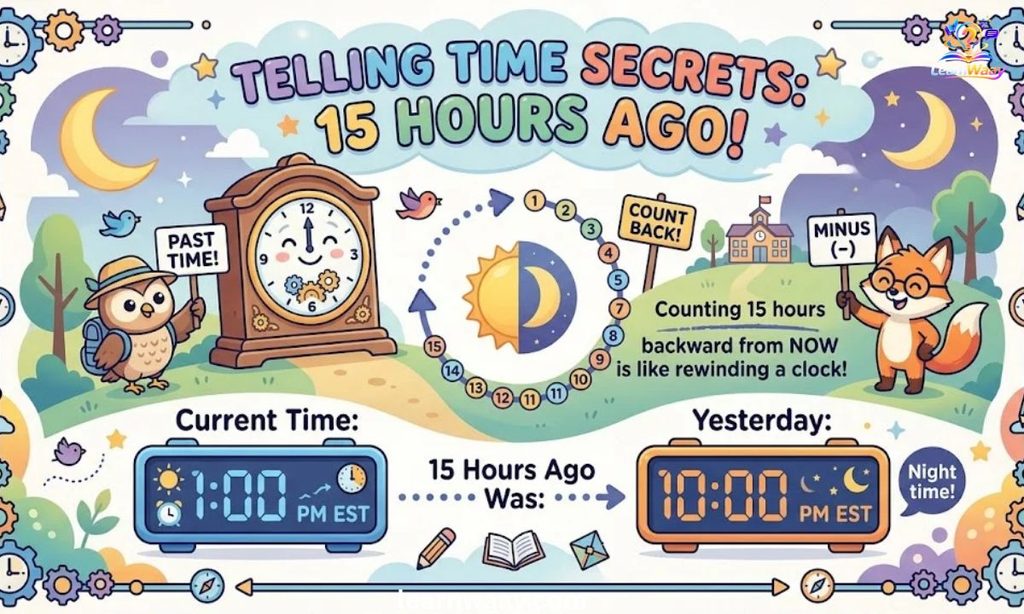
EST (Eastern Standard Time) is UTC−5. In summer, the region uses EDT (UTC−4), so make sure you pick the one that applies. Example: it is 1:00 PM Eastern. Fifteen hours ago was 10:00 PM the previous day.
What Time Was It 15 Hours Ago 2022
The year does not change the arithmetic. It matters only for dates and clock changes. If you are looking back at a 2022 timestamp, use the date as well as the time, and check whether daylight saving time began or ended within the 15-hour window in that region.
What Time Was It 15 Hours Ago PST
PST (Pacific Standard Time) is UTC−8. In summer, the region uses PDT (UTC−7). Example: it is 6:30 AM Pacific. Fifteen hours ago was 3:30 PM the previous day.
15 Hours Ago From 9am
9:00 AM − 15 hours:
- 9 hours back reaches midnight (12:00 AM).
- 6 hours remain, so 6:00 PM.
- The date moves back one day.
Answer: 6:00 PM the previous day.
Practical Examples
| Situation | Calculation | Result |
| Message received at 4:45 PM; when did the sender start typing the day before? | 4:45 PM − 15 h | 1:45 AM same day |
| A shift ends at 7:00 AM; when did it begin (15-hour shift)? | 7:00 AM − 15 h | 4:00 PM previous day |
| Fasting ends at 10:30 AM; when did it start? | 10:30 AM − 15 h | 7:30 PM previous day |
| Server log time is 02:20; check earlier event | 02:20 − 15 h | 11:20 the previous day |
Frequently Asked Questions
How do I calculate what time it was 15 hours ago?
Subtract 15 hours from the current time, adding 24 hours and moving back a day if you pass midnight.
Is 15 hours ago yesterday or today?
It is yesterday if the current time is before 3:00 PM, and today if it is 3:00 PM or later.
What is the shortcut for subtracting 15 hours?
Subtract 12 hours (flip AM/PM), then subtract 3 more hours.
How many minutes are in 15 hours?
15 hours equals 900 minutes.
Does daylight saving time affect the answer?
Yes, if a clock change falls inside the 15-hour window, the local time can be off by one hour.
What time was it 15 hours ago from 9am?
It was 6:00 PM the previous day.
What is the difference between 15 hours ago and 15 hours from now?
One subtracts 15 hours from the current time; the other adds 15 hours.
Conclusion
Finding the time 15 hours ago is simple once you use the right method. If you want to know what time was it 15 hours ago, subtract 12 hours from the current time and flip AM to PM or PM to AM, then take off 3 more hours to get the correct result. Pay attention to the date when your calculation crosses midnight, as the answer may fall on the previous day.
For accurate results, always consider your local time zone and any daylight saving changes that might affect the calculation. Whether you are checking a past event, reviewing a schedule, or calculating a time difference, understanding this simple method can save you time. For quick or repeated checks, an hours ago calculator can provide an instant answer without requiring manual calculations.

Ethan is an experienced blogger with 4 years of expertise in creating engaging, informative, and reader-focused content. He is currently working with Learnwaay.com, where he shares valuable insights and helps readers discover useful information through well-researched and engaging blog content.
